
TANGERANG SELATAN — What does a person truly need after earning a bachelor’s degree: merely a diploma, or the ability to remain relevant in a constantly changing world? This question is particularly important for Universitas Terbuka (UT) prospective graduates preparing to enter a new chapter after completing their higher education. In response to this challenge, UT held the Second Regional Graduation Seminar for the First Semester of the 2026/2027 Academic Year, carrying the theme “Smart, Ethical, and Globally Ready Generations,” on Monday (November 9, 2026), at the Universitas Terbuka Convention Center (UTCC), Pondok Cabe, Tangerang Selatan. The seminar featured Indonesian Minister of Religious Affairs Prof. Dr. K.H. Nasaruddin Umar, M.A., and Special Staff to the Vice President of the Republic of Indonesia for Education, Research, Innovation, and Downstreaming Achmad Adhitya, Ph.D.
For prospective graduates, graduation is not merely about completing academic requirements but also about being prepared to apply their knowledge in real life. UT Vice Rector for Academic Affairs and Student Affairs, Prof. Rahmat Budiman, S.S., M.Hum., Ph.D., reminded students that the degrees they are about to receive represent the results of their hard work, discipline, perseverance, and determination throughout their studies.
“The graduation you will receive tomorrow is not merely a symbol of academic achievement, but tangible proof of the hard work, discipline, perseverance, and determination that you have demonstrated throughout your studies,” he said.
According to him, an intelligent generation must possess critical thinking and problem-solving skills, as well as a commitment to continuous self-development. Integrity must also be reflected through honesty, responsibility, and ethics. This spirit of lifelong learning aligns with SDG 4 on Quality Education, which encourages every individual to continuously develop their knowledge and skills.
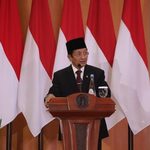
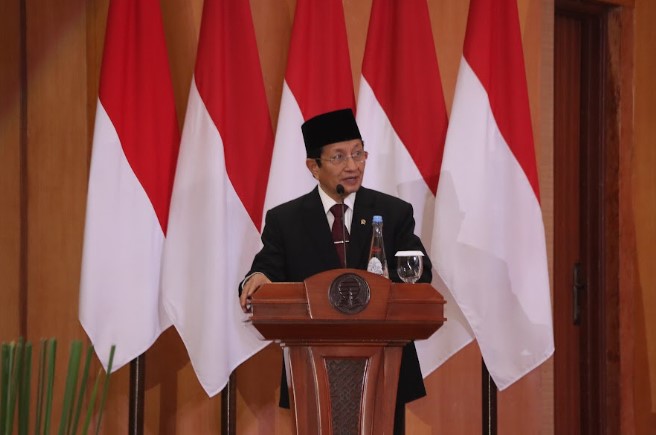
Perspectives on preparing for the future were also shared by Prof. Dr. K.H. Nasaruddin Umar, M.A. He considered UT’s learning model to be responsive to the needs of the times and even described UT as the “University of the Future.”
“UT is the University of the Future. In the future, all universities will become virtual universities. Universities of the future will not need buildings or rectorate offices. Everything will be centered on mobile phones,” he stated.
Nasaruddin also reminded UT students and graduates not to consider themselves inferior to graduates of other higher education institutions. According to him, a person’s quality is not determined by the label of their university, but by their ability to process and develop knowledge.
“Never introduce yourselves as second-class graduates. There is no such thing as a second-class or first-class university. What matters is the ability to process and develop knowledge,” he emphasized.
In addition to technological proficiency, graduates also need foreign language skills, the ability to build relationships, expand networks, and adapt to change. These competencies are essential for improving competitiveness and opening up broader employment opportunities, while also supporting decent work and economic growth, as outlined in SDG 8.
A message about character was delivered by Achmad Adhitya, Ph.D. He reminded prospective graduates that intelligence and achievements must be balanced with compassion and kindness. Through the experiences and stories he shared, he emphasized that Indonesia does not lack intelligent people but still needs more good-hearted individuals. “There are so many intelligent people in Indonesia, but we still need many more good people,” he said. He also stressed that a person’s quality is not determined by their university or background, but by their competence and commitment to self-development.
Furthermore, Achmad Adhitya, Ph.D. highlighted changes in the world of work driven by developments in artificial intelligence, robotics, big data analytics, and quantum computing. Technology does not merely eliminate jobs, it also transforms the types of jobs available and the skills required. Therefore, the willingness to continue learning and adapting is essential for graduates to remain relevant.
These perspectives emphasize that readiness for the future cannot be built solely through mastery of knowledge and technology. Integrity, compassion, and the ability to adapt continuously are also essential qualities for graduates. In line with this, UT’s commitment to expanding inclusive access to higher education for people from diverse backgrounds and regions also supports SDG 10 on Reduced Inequalities.
Ultimately, an academic degree is a foundation for taking the next step, but personal qualities determine the journey ahead. Smart, ethical, and globally ready generations are not merely those capable of keeping up with change, but also those who continue learning, care for others, and use their knowledge to make a positive contribution to society.