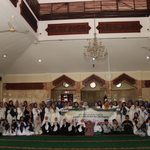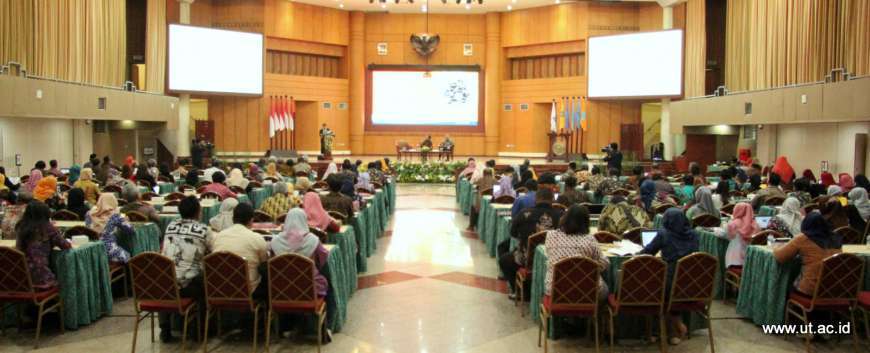

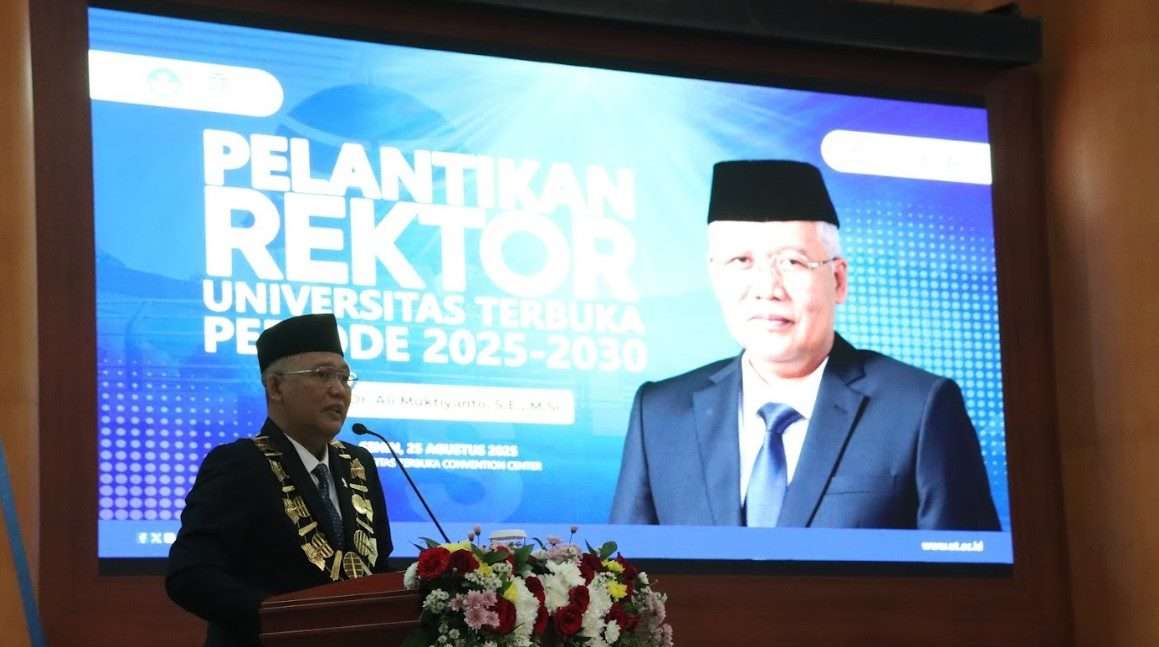
Pondok Cabe, August 25, 2025 — Universitas Terbuka (UT) officially enters a new chapter of leadership with the inauguration of Prof. Dr. Ali Muktiyanto, S.E., M.Si. as the Rector of UT for the 2025–2030 term. The inauguration and handover ceremony was held at the Universitas Terbuka Convention Center (UTCC), Pondok Cabe, South Tangerang, and led by the Chairperson of UT’s Board of Trustees (Majelis Wali Amanat/MWA), Prof. Ainun Naim, Ph.D., M.B.A. The event was attended by the Minister of Higher Education, Science, and Technology of the Republic of Indonesia, Prof. Brian Yuliarto, S.T., M.Eng., Ph.D., represented by the Expert Staff for Higher Education Ecosystem Strengthening, M. Hasan Chabibie, M.Si., along with ministry officials, university leaders, strategic partners, public figures, and the UT academic community.
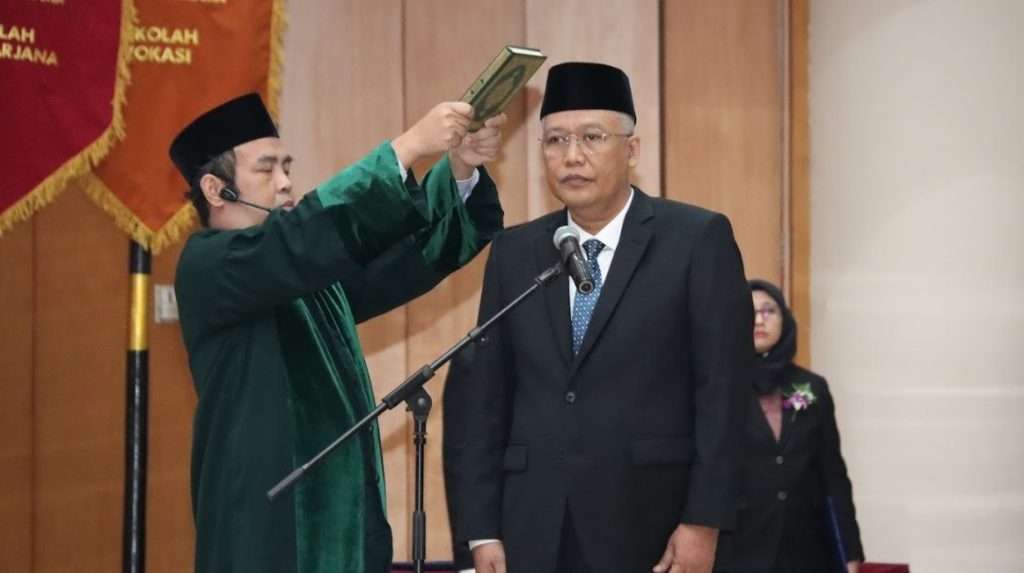
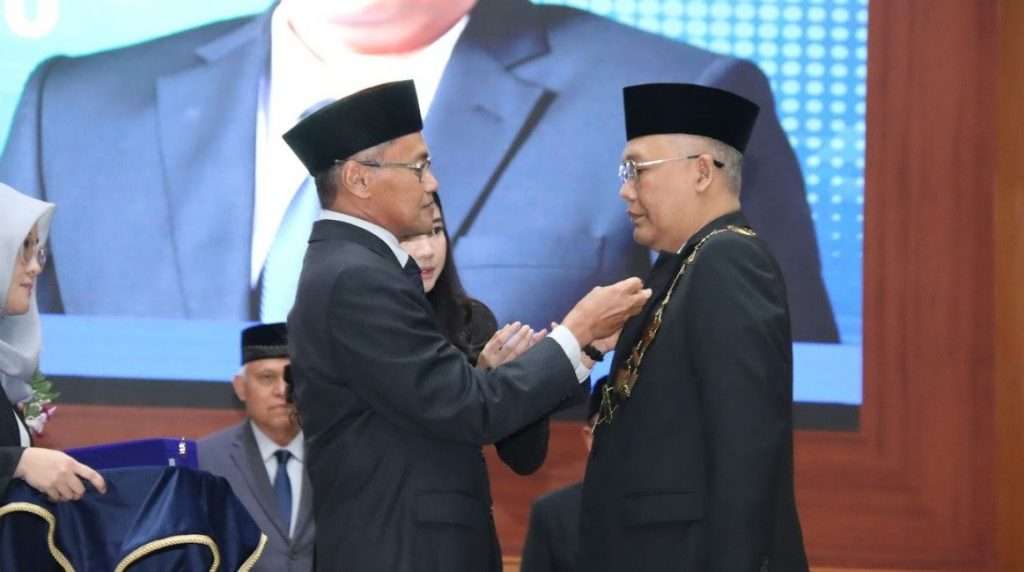
This event marks an important milestone in the leadership transition from Dr. Mohamad Yunus, S.S., M.A., who led UT for the past eight months, and Prof. Ojat Darojat, M.Bus., Ph.D., who had served for two full terms before being appointed as Deputy at the Coordinating Ministry for Human Development and Culture (Kemenko PMK).
Prof. Ali Muktiyanto, who previously served as Vice Rector for Finance, Human Resources, and General Affairs, was officially appointed based on the UT Board of Trustees’ decree regarding the dismissal of the 2021–2025 Rector and the appointment of the 2025–2030 Rector. His role will be guided by Government Regulation No. 39 of 2022 on UT’s status as a **State University with Legal Entity (PTNBH)**—the legal foundation that has driven UT’s transformation since 2022.
In his address, the Chair of the MWA expressed gratitude that UT’s leadership transition process went smoothly, transparently, and objectively. He saw this as a sign of UT’s maturity in governance as a PTNBH. He emphasized the continued importance of improving education quality and leveraging technology to expand educational access both nationally and internationally.
“We are grateful for a smooth leadership transition. The future challenges demand hard work and innovation. We believe Prof. Ali is capable of taking UT further as a Digital, Open, and Impactful Campus,” he said.
Prof. Ainun Naim also thanked all parties involved in supporting the rector selection process. Together with Prof. Dr. Chanif Nurcholis, M.Si., Chair of the UT Academic Senate, they emphasized the importance of aligning UT’s vision and mission with the Tri Dharma of Higher Education.
“Aligned with Prof. Ali’s tagline to enhance academic prestige, we hope that lecturers and students will increasingly contribute to community welfare. Under his leadership, UT should produce globally competitive graduates and further contribute to national progress toward Indonesia Emas,” said Prof. Chanif.
Representing the Minister, Dr. M. Hasan Chabibie, S.T., M.Si. emphasized that the inauguration was not just a change in office but a major mandate. He noted that UT, as a mega university, had grown dramatically from 350,000 students before the pandemic to over 750,000 students today.
“This is a remarkable achievement. UT’s PTNBH status will further streamline governance. We hope under Prof. Ali, UT becomes stronger, more resilient, and internationally recognized—supporting the President’s Asta Cita agenda to expand access to quality higher education.”
He acknowledged the contributions of past UT rectors and affirmed the strength of UT’s academic community, encouraging Prof. Ali to build on this foundation toward UT’s vision as a world-class university.
Former Rector Prof. Ojat Darojat echoed this sentiment, linking UT’s mission to the government’s vision of equitable access to higher education.
“Many prospective students face financial or geographic barriers. UT exists to ensure education is accessible to all levels of society.” “UT has already become an international reference. Now it’s time to support our new rector so UT can thrive even more,” he added.
Dr. Mohamad Yunus acknowledged the leadership handover as part of a natural process:
“UT colleagues are hardworking people who have made UT a source of pride. Now the baton has been passed. May this new energy strengthen UT for the future.”
Chair of the Rector Selection Committee, Prof. Dr. Paulina Pannen, MLS., praised Prof. Ali’s consistency and integrity during the selection process:
“We were looking for a star, and Prof. Ali is that star,” she said, hoping UT would continue to grow as a world-class open digital university.
In his inaugural speech, Prof. Ali Muktiyanto emphasized that UT is facing major transformations due to digitalization and globalization in higher education. These trends bring both opportunities and challenges.
“Digitalization and globalization are changing the landscape of higher education, both nationally and globally. Universitas Terbuka must differentiate, diversify, and create a higher education model that is fast, flexible, and organized.”
He noted UT’s strengths in flexible, tech-based, and inclusive learning systems. These advantages, he said, must evolve to maintain UT’s significant contribution to national development.
Prof. Ali cited UT’s long-term vision in its 2025–2045 Strategic Plan (RPJP):
“To Become a World-Class Quality Open and Distance Higher Education Institution.”
He outlined five strategic directions through 15 priority programs focusing on:
- Empowering entrepreneurship
- Improving access and quality of education
- Impactful research and innovation
- Global competitiveness
- Good governance and cultural transformation
He also delivered a scientific oration titled:
“Strategic Steps of Universitas Terbuka Toward Global Open Distance Higher Education Based on Academic Excellence, Learning, and Graduates.”
Prof. Ali introduced the SHINE–STARS–RID transformation roadmap:
- SHINE (Spirit, Horizon, Innovation, Nurture, Entrepreneurship): a foundation that cultivates innovation and academic entrepreneurship.
- STARS (Synergy, Transformation, Accountability, Relevance, Scalability): the strategic engine for modern governance, wide collaboration, relevance to industry, and service expansion.
- RID (Reputation, Integrity, Dignity): the targeted outcome—UT’s global academic reputation, integrity, and prestige.
“UT’s reputation is not just built on accreditation but also on the integrity of its graduates, faculty competitiveness, and real contributions to the nation. SHINE–STARS–RID is our compass for the future,” he affirmed.
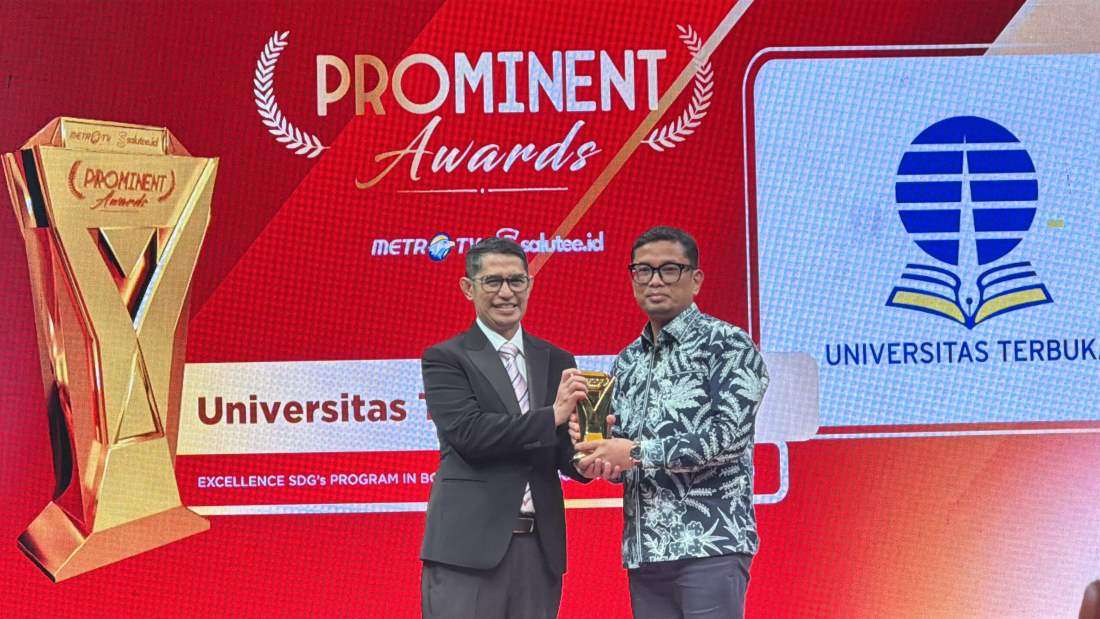
The inauguration of the 2025–2030 Rector also marked UT’s renewed commitment to supporting the Sustainable Development Goals (SDGs), particularly:
- SDG 4 (Quality Education) – through borderless, time-independent higher education access
- SDG 9 (Innovation and Infrastructure) – with cutting-edge digital tech, AI, and the Digital Learning Ecosystem (DLE)
- SDG 10 (Reduced Inequalities) – by opening access for underserved and remote communities (3T regions)
- SDG 17 (Partnerships for the Goals) – via global collaborations with OU5, edX, ICDE, and other international partners
Prof. Ali concluded his speech with a meaningful traditional pantun (Malay verse):
“The morning sun breaks on the horizon, Its light guides our direction and mission, With SHINE–STARS–RID as our shared vision, We strive for excellence with strong conviction.”
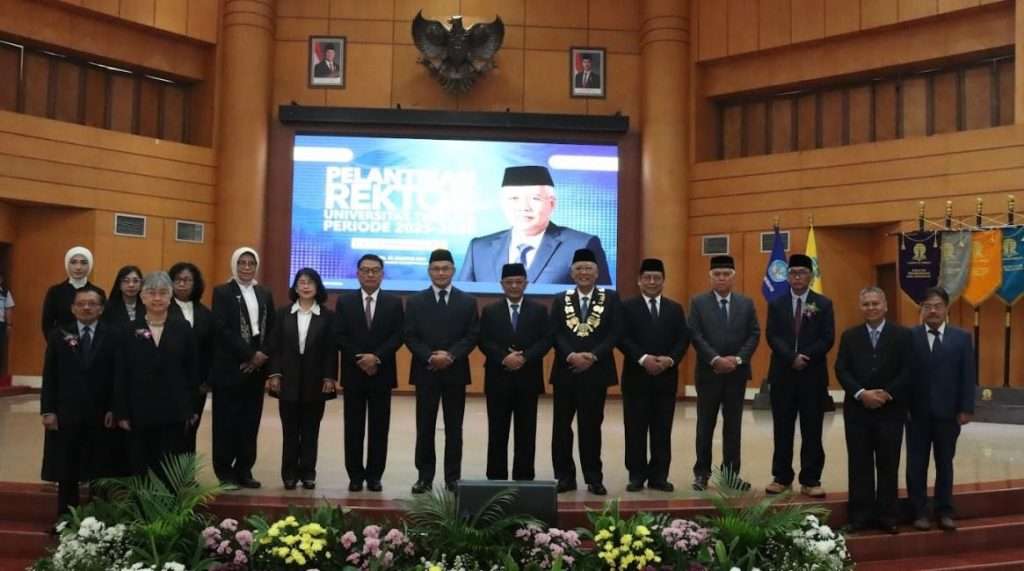
With this spirit, Universitas Terbuka is committed to moving forward—enhancing academic prestige, expanding inclusive education access, and affirming its identity as a digital, open, and impactful university for Indonesia and the world.