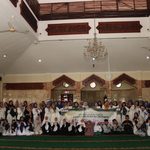


The Sustainable Development Goals (SDGs) represent a global vision for peace, prosperity, and the future of development. In an effort to support the achievement of the SDGs, Universitas Terbuka (UT), through the Faculty of Science and Technology (FST), organized The 4th International Seminar of Science and Technology (ISST) on October 17, 2024. ISST is an annual event organized by FST, serving as a platform for the academic community to disseminate academic products in the fields of science and technology in line with the predetermined theme. This year’s international seminar, with the theme “Innovations in Science and Technology to Realize Sustainable Development Goals,” became an important platform for sharing innovations in science and technology, while also demonstrating UT’s commitment to realizing the SDGs.
This hybrid seminar was attended by around 117 presenters, with 45 attending in person at the Universitas Terbuka Convention Centre (UTCC) and 72 attending virtually via Zoom, with the event streamed live on Universitas Terbuka’s YouTube channel. The event was opened by UT Rector, Prof. Ojat Darojat, M.Bus., Ph.D., who delivered a virtual speech, expressing appreciation to FST for organizing The 4th ISST. He emphasized that this seminar is a tangible step by UT in supporting the SDGs, particularly through research and innovation relevant to global needs. This aligns with the seminar’s objective of encouraging academics to continuously contribute to science and technology.
Dr. Mohamad Yunus, M.A., Vice Rector for Academic Affairs, representing the Rector, further explained that this event aims to foster dedication among faculty members within and outside UT to produce valuable outputs that can enhance their scientific standing. “The hope is that new contributions will be made to science and technology that will continue to develop and improve, strengthening the presence of scientific research within the Ministry of Education, Culture, Research, and Technology,” added M. Yunus.
This international seminar invited the Directorate General of Higher Education, Research, and Technology, represented by Prof. Dr. rer. nat. Abdul Haris, M.Sc., with Prof. Dr. Ir. M. Faiz Syuaib, M.Agr., Director of Research, Technology, and Community Service, in attendance. The seminar also featured speakers from prestigious educational institutions, with George Xu from H3C China and Dr. Pismia Silvy, S.Si., M.Si. from UT’s Statistics Program, FST, speaking in person at UTCC. Additionally, virtual speakers included Paul Burton from Griffith University, Australia, and Dr. Yury Bukhman from the Morgridge Institute for Research, USA.

On the same occasion, the Director of Research, Technology, and Community Service (DRTPM) at the Ministry of Education, Culture, Research, and Technology, Prof. Dr. Ir. M. Faiz Syuaib, expressed his appreciation for this event and commended ISST, which is held annually by UT, as a positive and beneficial tradition. According to him, universities are at the forefront of a nation’s progress. “This annual ISST event at UT is certainly a good tradition. Nowadays, we cannot avoid technology, and technology cannot be produced or used if we do not understand it. Universities are at the forefront. No country or nation can progress if its universities do not advance,” emphasized Prof. Faiz Syuaib.
Prof. Faiz further explained that building a good university reputation must begin with research achievements and technological advancements, both in terms of quantity and quality, accompanied by information dissemination and the publication of research products to gain recognition. “Reputation is the highest achievement. Reputation is built because we have the numbers, we have the quality, and we are visible to others. Then, people acknowledge us. Researchers would never know what others are doing without meeting each other,” he added.
Prof. Faiz also emphasized that UT is an extraordinary asset in terms of its history, skills, and contemporary relevance. Given the vastness of Indonesia, it is impossible to develop the same inventions or discoveries in every region. “With research and technology, we should be able to solve our problems, and learning technologies will help shape what needs further research in the future,” said Prof. Faiz.

This seminar was particularly special as it was part of the series of events celebrating Universitas Terbuka’s 40th Anniversary. During this seminar, ISST also launched two books written by lecturers from the Faculty of Science and Technology, Universitas Terbuka. The first book, titled “Alternative Food from Various Local Commodities in Indonesia,” is dedicated to helping the public become more familiar with various local commodities in Indonesia that can be used as alternative food sources. By recognizing more local commodities as food sources, it is hoped that the diversity of food consumption will increase, which in turn will strengthen food security in Indonesia. This book contains 10 articles explaining the potential of local food, including tubers, fruits, cereals, and insects. The second book, titled “Agribusiness Strategy,” covers agricultural development, agribusiness concepts, agribusiness developments, agribusiness development strategies, agribusiness innovations, the future of agribusiness, and how to prepare to become an entrepreneur.
At the end of the event, awards were announced for the winners of Best Paper, Best Poster, and Best Presenter. The 1st, 2nd, and 3rd place winners of Best Paper in the Non-Student category were: 1) Ardhana Reswari Utami, Bambang Widigdo, Sulistiono, Agustinus M. Samosir, Etty Riani, and Ayu Ervinia (IPB University) for “Pollution Status and Water Carrying Capacity for Intensive Vaname Shrimp Cultivation on the Cilacap Coast, Central Java”; 2) Whika Febria Dewatisari, Einstivina Nuryandani, and Hariyadi (Universitas Terbuka) for “Alkaloid Diversity in Mitragyna speciosa (Kratom) Influenced by Strain Characteristics and Geographic Source”; and 3) Lia Yulia Budiarti, Ellanda Permata Derlin, Maulidia Khairada Amalia, Fahdyanoor, Shofia Hilwa Ihsanti, and Yafi Fahmi (Lambung Mangkurang University) for “Ability Test of Taro (Colocasia esculenta L.) Leaves Extract to Reduce Coliform Bacteria in River Water.”
Meanwhile, the 1st, 2nd, and 3rd place winners for Best Paper in the Student category were: 1) Asep Saepulloh (Institut Teknologi Bandung, Planning, Research & Development Board of Banjar Municipality) for “Challenges and Opportunities of Land Degradation Neutrality Implementation in Various Countries and Its Implications for Indonesia: A Systematic Review”; 2) Aulia Floribunda Harp1, Mia Kosmiatin2, Agus Purwito1, Ali Husni2, and Kristianto Nugroho2 (1IPB University, 2BRIN) for “Induction of Embryogenic Callus Formation and its Regeneration in Polyploid Allium Sativum var. ‘Lumbu Hijau’”; and 3) Aliefi Mutiara Syafitri1, Mona Dwi Fenska2, Anisa Nuraeni2, Bambang Herwanto2, Adittya Dwi Apriadi2, and Ilham Fajar Subakti2 (1Universitas Terbuka, 2PT Sanghiang Perkasa) for “Characterization and Application of Distillation By-product from Kjeldahl Protein Testing as a Liquid Medium for Air Pollution Control.”
The 1st, 2nd, and 3rd place winners for the Best Poster in Subtheme 1: Collaborative Contribution in Environmental Science to Achieve Sustainable Living were: 1) Aliefi Mutiara Syafitri (Universitas Terbuka), 2) Fiona Putri Septiani (Universitas Islam Negeri Sunan Gunung Djati Bandung), and 3) Santi Wiji Rahayu (Universitas Terbuka). For Subtheme 2: Role of Agricultural Science for Sustainable Food Production, the 1st, 2nd, and 3rd place Best Poster winners were: 1) Agung Supriatna (Universitas Terbuka), 2) Syabilla Dewi Nur Maharani (Universitas Mercu Buana Yogyakarta), and 3) Nurasiva (Universitas Terbuka). Meanwhile, for Subtheme 3: Technological Innovations in Natural Science for a Sustainable Environment, the 1st, 2nd, and 3rd place Best Poster winners were: 1) Pristy Tasya Nabila (IPB University), 2) Kurnia Nurlaili (Universitas Terbuka), and 3) Dinar Wahyu Rahman (Universitas Terbuka). The most anticipated award, the Favorite Winner, went to Syabilla Dewi Nur Maharani (Universitas Mercu Buana Yogyakarta).
The 1st, 2nd, and 3rd place winners for Best Presenter in the Student category were: 1) Angga Puja Asiandu (Universitas Gadjah Mada) for “The Superior Astaxanthin Producer: Optimization of Environmental Factors in Haematococcus pluvialis Two-stage Cultivation to Enhance its Growth Rate and Astaxanthin Accumulation as the Strongest Natural Antioxidant”; 2) Desya Amalia Wibowo (Universitas Muria Kudus) for “Proximate Analysis of Commercial Stunting Alleviation Foods: Nutrimora Cookies Case Study”; and 3) Sultan Ahmad Dzakwan (Universitas Terbuka) for “Morphometric Study of Green Peacock Feather as Material for Dadhak Merak of Reog Ponorogo.” In the Non-Student category, the 1st, 2nd, and 3rd place Best Presenter winners were: 1) Ismail Hasvi (Universitas Terbuka) for “Analyzing Formal Credit Access in Financial Technology Utilization by Chili Farmers in Sukabumi Regency (A Case Study at PT. Crowde)”; 2) Made Diyah Putri Martinasari (Universitas Terbuka) for “The Impact of Climate Factors and Land Area on Rice Production in Bali: A Regression Analysis for Agricultural Sustainability”; and 3) Septariawulan Kusumasari (Universitas Sultan Ageng Tirtayasa) for “Utilization of Extrusion Techniques in Pasta Processing from Beneng Taro Flour and Durian Rind Flour.”
Through the organization of The 4th ISST, Universitas Terbuka demonstrated its commitment to supporting the government in achieving sustainable development goals (SDGs) by strengthening research in science and technology. By continuously involving academics and researchers from both domestic and international institutions, UT is ready to produce relevant and impactful innovations, both nationally and globally. This event is expected to spark more collaboration and innovative ideas that will drive the achievement of the SDGs and further strengthen UT’s position as a solution-oriented, innovative higher education institution ready to compete internationally.